Español · English
A twelve-year vow
Breathing the Mahabharata is a vow to spend twelve years living within the great initiatory work known as the Mahabharata. Conceived as an artistic ritual, the commitment takes place between 2016 and 2027: every 12 December, a new version of the oral telling is premiered.
Alongside the annual premieres, I offer other storytelling performances and courses on mythology, metaphysics and storytelling, working with the traditional symbolism of India as it appears in the Mahabharata.
To keep the Mahabharata constantly in mind throughout these twelve years, I undertake to publish a piece of writing about it every fortnight on this website. These essays share lesser-known stories, principal symbols and reflections.
I make this vow out of respect for the Mahabharata and India’s storytelling traditions. Telling the Mahabharata matters; by doing it for twelve years, I am the one being transformed in its hands, moving beyond my own boundaries in search of its teaching.
A brief chronology
Year One: Breathing the Mahabharata I — Las semillas (The Seeds)
• In spring 2014, the idea emerges of preparing an oral storytelling event based on the Mahābhārata. Out of respect for its depth, complexity and length, I decide to allow myself several years of preparation. Sensing that the proposal will absorb much of my attention for years, I consider sharing the process online and in public, as a living installation unfolding over time.
• In September 2014, during a meeting with director María Stoyanova, she proposes giving the project fixed dates and a defined number of years, and regularly presenting the work in progress. We choose twelve years, with a new chapter every 12 December. Initially, the episodes were not intended to continue the same plot: the aim was to show the evolution of the telling, which involves method and quality as much as content. The first seven years nevertheless followed a continuous narrative.
• In October 2015, preparation begins for the first episode at Atelier Escènic, María Stoyanova’s working group. The idea of writing a blog post every fortnight emerges: a way of requiring myself to stay connected with the Mahābhārata throughout each year of this living installation.
• From autumn 2015, I spend every Wednesday afternoon at a table in the tea house of the Mailuna cultural centre, telling anyone who joins me stories from the Mahābhārata and its cosmology.
• In June 2016, a work-in-progress version of the first episode is presented at the Experimental Room Festival, on Karel Mena’s terrace, in collaboration with Terrazas de Barcelona. Directed by María Stoyanova, with actress and singer Gisele Cornejo, the installation invites visitors to watch a video, write a response to an existential question related to the Mahābhārata, light a candle and play Lilah before gathering in a circle to hear stories mainly from its first book, the Adi Parva.
• On 12 December 2016, the installation’s first episode, Las semillas, is presented. It combines the installation shown at Experimental Room with four hours of storytelling introducing the Mahābhārata and the Adi Parva. Live music composed for the occasion is performed by Adriana Alcaide, Ofer Ronen and Gisele Cornejo. Gisele also recites texts in a theatrical register, distinct from the oral storytelling.
• June 2017: Breathing the Mahabharata I is presented in the Menhir gardens in Mollet del Vallès, with live music by Hamsa Hamsa and recitation and singing by Gisele Cornejo. Organised by CRA’P.
• July 2017: storytelling of extracts from the Mahābhārata at Equilibrium’s yoga teacher-training seminar in Barcelona.
Year Two: Breathing the Mahabharata II — El encuentro (The Encounter)
For the second year, we experiment with non-linear storytelling based on the ancient Egyptian board game Senet. The stage, or gathering space, becomes a large board. Gisele Cornejo and I play a symbolic game in which my pieces are stories about characters from the Mahābhārata; hers are songs, texts and ritual-theatre gestures based on their partners. Narratives, songs and recitations combine through improvisation and spontaneous movement. Listeners sit in a circle around the board and participate with questions and comments. Approximate duration: two and a half hours.
• 12 December 2018: premiere of Breathing the Mahabharata II: El encuentro at Respiro Yoga in Buenos Aires, with Gisele Cornejo and live music by the mantra and Hindustani music ensemble Ananda.
• December 2018: Breathing the Mahabharata II at Hastinapura in Buenos Aires, at the invitation of Gustavo Canzobre, a teacher at Hastinapura and promoter of Radio Niketán Cultura. With Gisele Cornejo and live music by Diego Poggi.
• June 2018: Breathing the Mahabharata II in the Menhir gardens in Mollet del Vallès, with Gisele Cornejo and live music by Ofer Ronen.
• Winter 2018: collaboration begins with Toni Cots, a specialist in experimental performance languages. We rehearse storytelling supported by unconscious physical expression. Rather than controlling the body through planned gestures, we investigate how words affect bodily sensitivity and how that sensitivity changes public speech.
Breathing the Mahabharata III — La coronación interior (The Inner Crowning)
The third year is marked by my daughter’s gestation and birth. With Toni Cots, I work on the burning of the Khandava forest and its consequences and symbolic resonances. The inner crowning is the baby’s passage through the mother’s pelvis just before birth; the eternal fire is the vital energy transforming everything. The telling rests strongly on a gestural language at the threshold of dance, adaptable to any space, with the intention of performing in private homes and places outside conventional stages.
• 12 December 2018: Breathing the Mahabharata III is presented in my dining room. My daughter is fourteen days old. To remain close to her while fulfilling my vow to premiere a new episode every 12 December, I perform for my wife Gisele Cornejo, our daughter Sarah Luna, my mother-in-law Graciela Perez, Toni Cots and Esther Freixa, co-director of CRA’P.
• Winter 2019: Breathing the Mahabharata III is presented in two private homes.
• June 2019: Breathing the Mahabharata III at CRA’P, to mark the visit of Lakshman Gurukkal, master of the Indian martial art Kalaripayattu.
Breathing the Mahabharata IV — Antarayatra: The Inner Pilgrimage
The fourth year revolves around the Mahābhārata’s dice game involving Yudhishthira and Shikandi, the symbolism of chance, and the game’s narrative and existential implications. I also enter a period of intense painting, repeatedly feeling the need to give visual form to images from the work. These paintings become part of a folding Lilah board that brings together the symbolism of the Mahābhārata’s cosmology. Some paintings are sold at presentations of the fourth chapter.
For Breathing the Mahabharata IV, participants are randomly divided into five teams to play Lilah. Each square is associated with a story from the Mahābhārata, so the course of the game determines which episodes are told. At the end, each team presents how it has experienced the journey inwardly.
• 12 December 2019: Breathing the Mahabharata IV at CRA’P. During the lockdown beginning in early 2020, I start telling extracts on video for social media and at the invitation of yoga schools such as Equilibrium Yoga Shala.
Breathing the Mahabharata V
I could not find a title for the fifth chapter. The process follows the Pandavas’ concealment in the kingdom of Matsya, up to the revelation of Arjuna’s disguise. With actress and singer Gisele Cornejo, the performance explores the polarisation of masculine and feminine energy. Gisele creates and performs fragments based on the narrative, interwoven with the storytelling. Directed by Toni Cots, the format combines live and online presentation to include people who followed that year’s online sessions.
The presentation spans three weekends. On 5 December, the weekend before the premiere, I give an online general introduction to the Mahābhārata.
On the morning of 12 December, we present the fifth-year telling, with Gisele Cornejo’s performance, to a very small audience at CRA’P. That evening, I tell the same episode online from home.
On 19 December, we hold a closing online gathering where participants share some of the reflective exercises offered during the process.
• 12 December 2020: premiere of Breathing the Mahabharata V online and at CRA’P. Throughout 2020, I also offer online courses and storytelling sessions with extracts from the Mahābhārata.
Breathing the Mahabharata VI — First Portal: The Oracle
In winter 2020, I begin immersing myself in the Mahābhārata’s long account of the war. This brings a deep crisis concerning the project’s meaning and its intended audience. Meanwhile, a Mahābhārata-based tarot, developed with tarot practitioner Gisele Cornejo since around 2014, begins to take shape. During a creative retreat with Toni Cots and Gisele at CeRCCA, at Pau Catà’s invitation, the idea emerges for a retrospective installation with video, sound, a reading space and an interfaith altar. Participants take turns receiving a personal reading of the Mahābhārata tarot. The format brings together the individual encounters at Mailuna, which ended in 2019, and everything learned since 2015. Duration: two hours, for up to twenty-four people.
• 12 December 2021: two consecutive performances of Breathing the Mahabharata VI at Equilibrium Yoga in Barcelona.
• February 2022: Breathing the Mahabharata VI at Brava in Barcelona.
• June 2022: Breathing the Mahabharata VI at Kaivalya in Barcelona.
Breathing the Mahabharata VII — Return to the Origin
During 2022, I rehearse regularly with Abdul Karim, a musician specialising in bansuri flute and Hindustani music. We develop narratives shaped by the Hindustani understanding of music: episodes of the Mahābhārata told through an understanding of the world as sound. We present several storytelling and music gatherings called Historias para recordar (Stories to Remember). Although not individually listed here, they form part of the maturation of the Mahābhārata telling.
Throughout 2022, I remain immersed in the long war narrative, a process continuing into 2023. It brings deeper crises. Amid the desolation of reflecting on war, dissolution and conflict, I find support in the Bhagavad Gita, where Krishna speaks to Arjuna about life’s meaning on the battlefield. For the seventh year, I feel a need both to speak about the Mahābhārata and to strip the format back to storytelling alone. Return to the Origin lasts four hours. Listeners sit around candles; we begin shortly before sunset, while natural light remains. The telling follows the whole narrative from beginning to end in condensed form, emphasising Krishna. It concludes with a brief account of the Bhagavad Gita, its continuation, the Anu Gita, and a meditation based on Krishna’s final discourse to Uttanka after the war. • 12 December 2022: Breathing the Mahabharata VII at CRA’P.
Breathing the Mahabharata VIII — Second Portal: Surrender
During the seventh episode, I felt a lack of connection and listening with the audience. Throughout 2023, Toni Cots and I work on listening through bodily presence. I participate in the Lab, a research group on listening with the body, guided by Toni.
2022 brought many personal losses and required me to acknowledge realities to which I had paid insufficient attention. This led me to the subtitle Surrender: surrender in a positive sense, ceasing to struggle against reality and recognising both difficulties and possibilities. Collectively, it also means acknowledging destruction, injustice and suffering in the world.
I return to the portal motif introduced in the sixth year. Having named that episode First Portal, I feel the portals need a continuation, and the eighth year unexpectedly becomes another threshold.
On 4 December 2023, we hold the general rehearsal at CRA’P: a four-hour telling of the Mahābhārata’s plot. We begin before sunset, seated around candles that become increasingly prominent as darkness falls; no other lights are turned on.
The rehearsal resembles the seventh year’s format, but without the Bhagavad Gita. This time the work centres on listening and presence, with no resources beyond the narrative and the body. The telling follows only the Mahābhārata’s plot, trusting the words themselves to do the subtle work of the encounter. The experience is hopeful and pleasurable, leaving a sense of connection and renewal.
The 12 December premiere takes place at a secret location about which I cannot say more. It is a unique, unrepeatable event. Condensing the Mahābhārata into two hours is difficult, yet the listening and subtle connection with those present reach greater depth than in rehearsal, largely thanks to the conditions of the host space.
During the premiere, I understand the second portal as the end of the war phase within this twelve-year telling. The Mahābhārata can be understood in three parts: the events leading to Kurukshetra, the war itself, and counsel for living afterwards. Each occupies roughly comparable space—more than two thousand pages—and the twelve-year vow can likewise be divided into three four-year periods. As the eighth year ends, I feel it is time to leave the war behind. Even if more could be said or done, this too belongs to the work: one life cannot reach all its depths. It also belongs to war and conflict: something is always left on the battlefield. But a time comes to begin working for peace and shared life. This is the work opening with the ninth year.
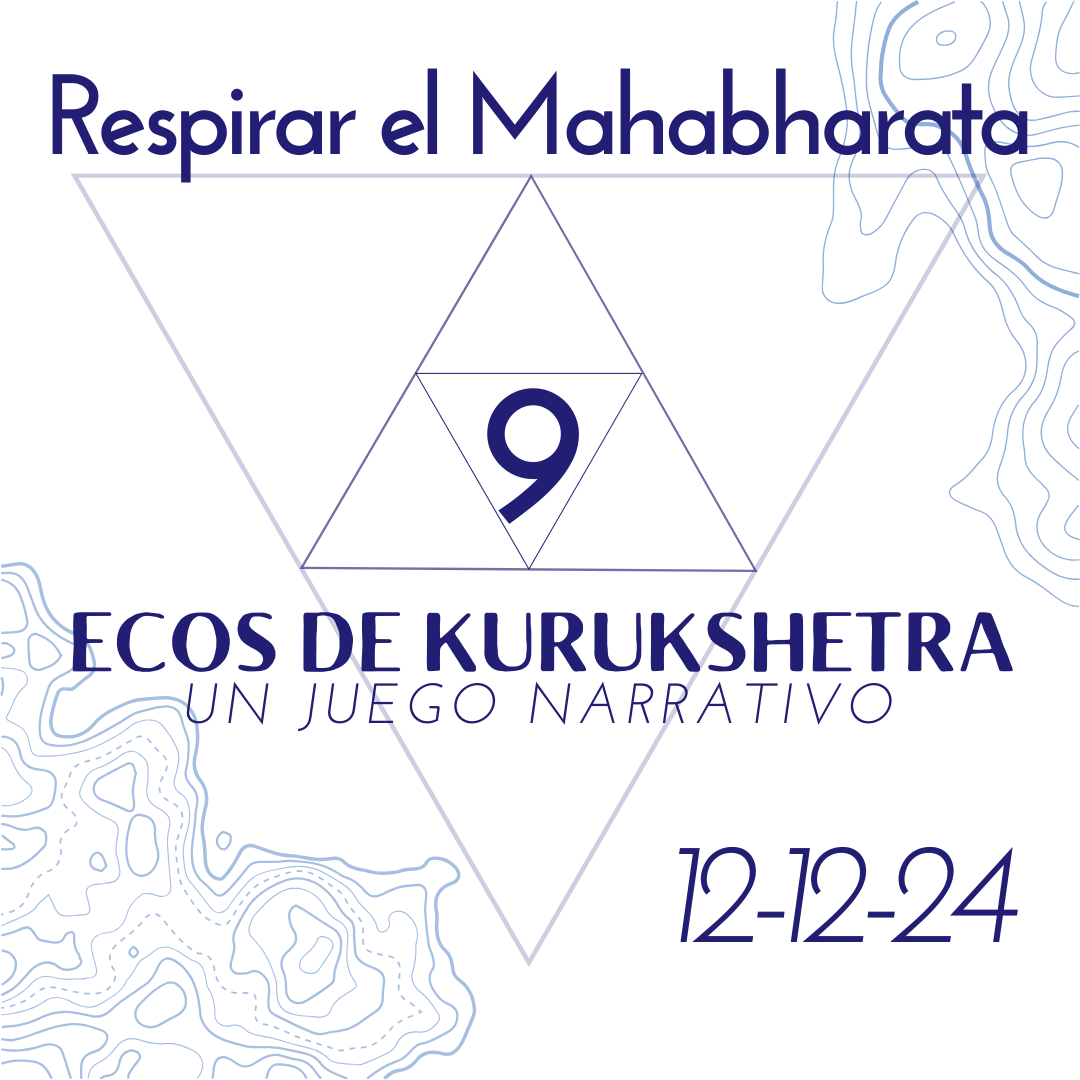
Breathing the Mahabharata IX — Ecos de Kurukshetra (Echoes of Kurukshetra): A Narrative Game
- March 2024: an artistic residency at Nau Côclea. This year’s process leads me towards storytelling in movement, telling the Mahābhārata while walking through cities and forests. This interest brings me into contact with Clara Garí and her sustained work in walking art; she invites me to the Grand Tour.
- June 2024: a meeting with Joad Adell Lavé and Marta Ruzafa Artigas of Sat Nam publishers inspires me to spend the summer inventing board, role-playing and narrative games based on the Mahābhārata. This approach begins to define the direction of the ninth year’s conclusion.
- September 2024: with Toni Cots’s guidance, the game takes its final form in autumn, ahead of its 12 December presentation. It combines the urban drifting and walking art explored earlier in the year with the subsequent exploration of board games, creating a narrative journey through an inner map based on the Mahābhārata.
- 12 December 2024: premiere of Breathing the Mahabharata IX at Musubu cultural centre, Barcelona. Twelve people play Ecos de Kurukshetra, tracing a collective inner map. The remaining attendees form the audience, whose presence gives context to the players and affects their responsibility within the encounter.
Continuing Year Nine: Ecos de Kurukshetra
• 11 January 2025: Ecos de Kurukshetra at CRA’P in Mollet del Vallès. Following the Musubu premiere, the gathering further develops the relationship between storytelling, participation and the mapping of a collective inner landscape. The telling changes with the people gathered and the relationships emerging among their stories.
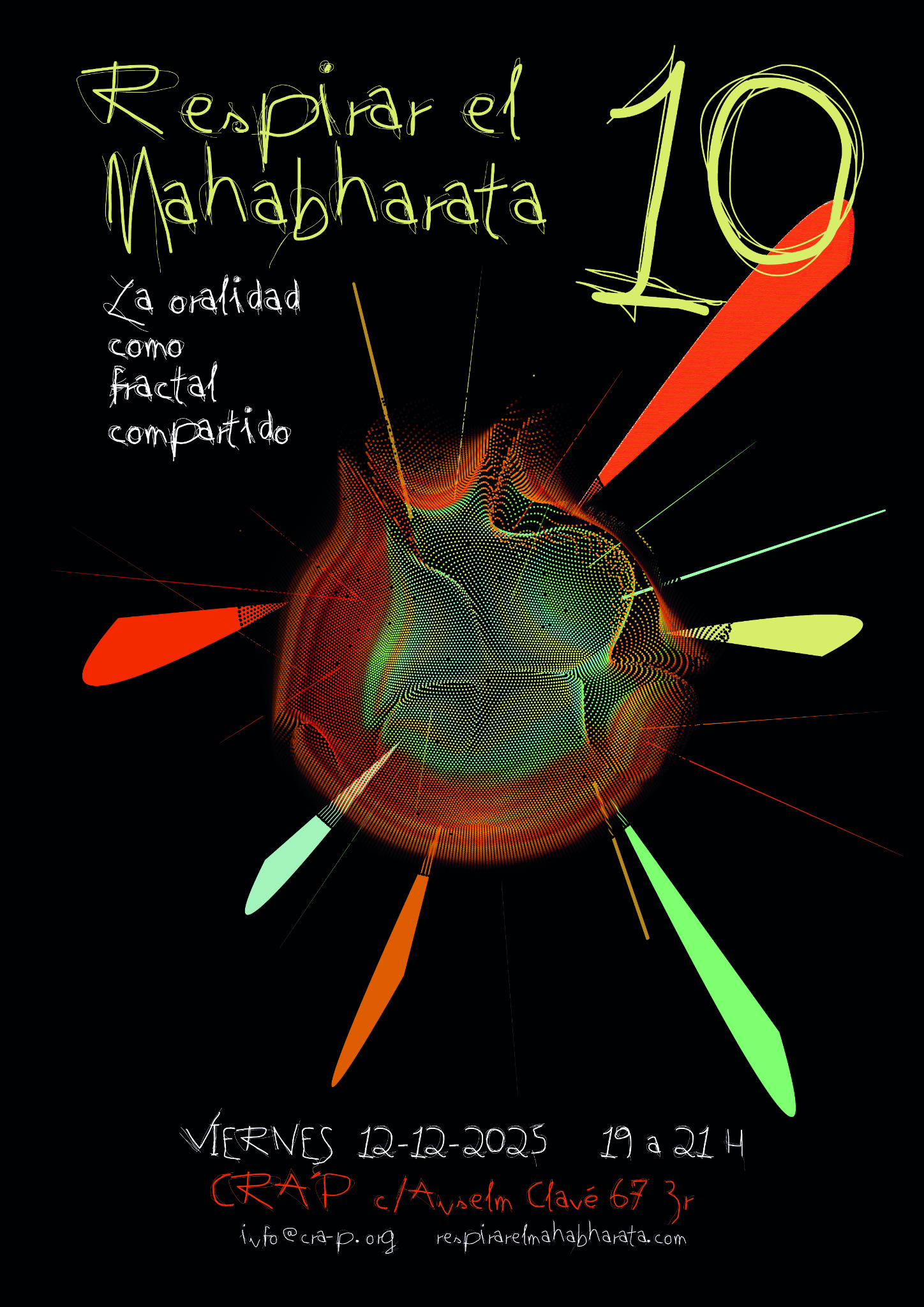
Year Ten: Breathing the Mahabharata X — Fractal Storytelling
During the tenth year, I continue investigating how to share the Mahābhārata without reducing it to a sequence of events. The work contains stories within stories, questions opening new narratives and characters viewing the same conflict from different positions. This structure becomes a guide for the telling.
The audience’s questions shape the journey and determine which stories are told. Listening is no longer merely the reception of a narrative: it participates in its composition. Each encounter opens a different entrance to the Mahābhārata and produces a telling that cannot be repeated in the same way.
• 2025: alongside the project, I participate in LABA Barcelona, a space for studying Jewish texts and making art. There I develop Cartografías del viento (Cartographies of the Wind), with illustrator Fernando Cardona Pons. This book and participatory narrative proposal addresses memory, displacement and the possibility of understanding diaspora as home. Although a distinct project, it shares with Breathing the Mahabharata the question of the stories through which we understand ourselves, and how they change when we tell them together.
• 31 October 2025: presentation of Cartografías del viento at LABA LIVE, at Barcelona’s Convent de Sant Agustí. On the same day, Ofer Ronen and I present the musical work La Mirada. These collaborations extend the dialogue between words, music, memory and shared experience accompanying my storytelling practice.
• 12 December 2025: presentation of the tenth episode at CRA’P, exploring orality as a shared fractal. The gathering brings together the research into open-ended storytelling, shaped by the relationship between stories and listeners.
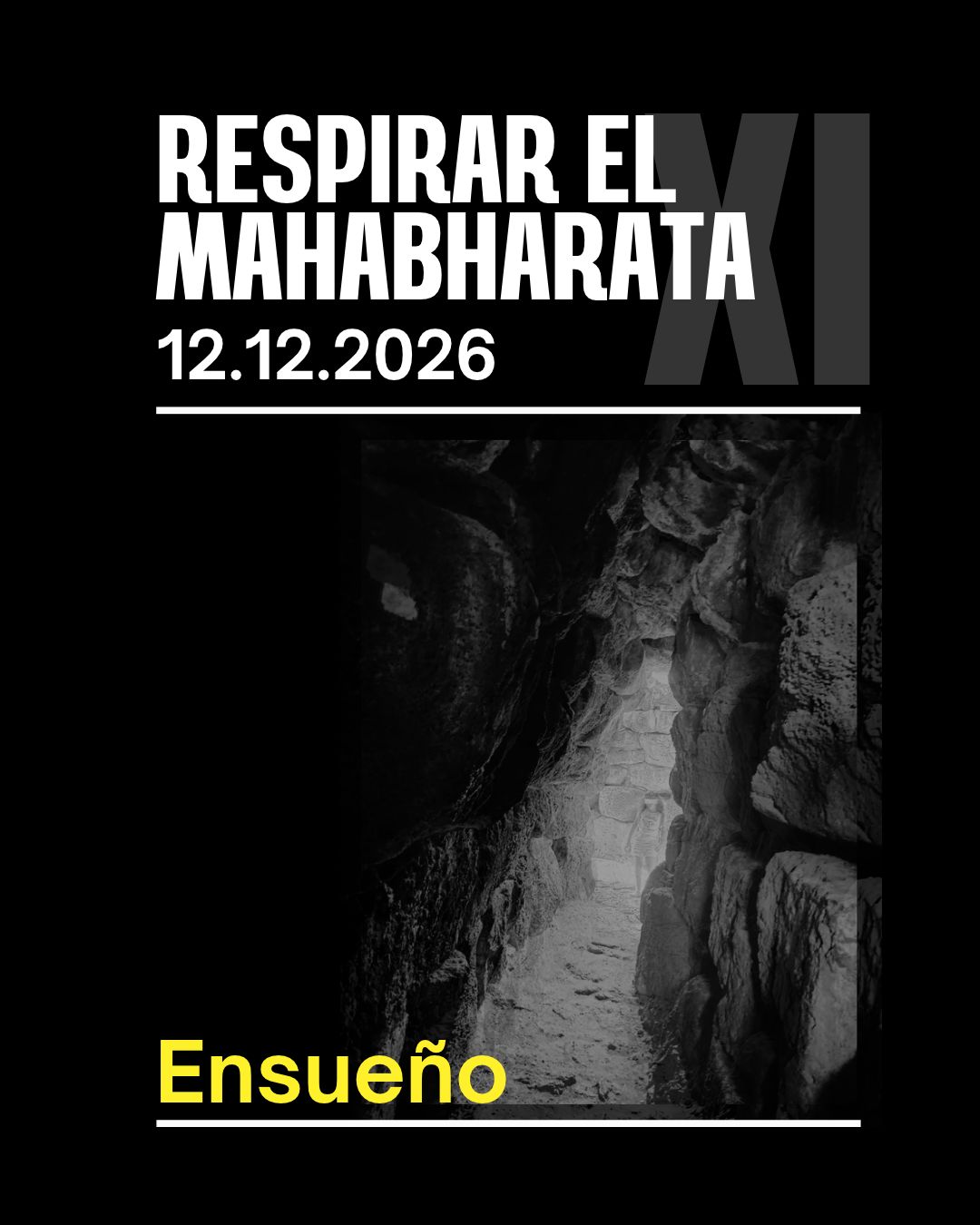
Year Eleven: Breathing the Mahabharata XI — Ensueño (Reverie)
During 2026, the research moves towards the threshold between waking and dreaming. After working with chance, boards and audience questions, I become interested in what happens when participation takes a quieter form: resting, listening and allowing the story’s images to unfold through the body.
The audience listens lying down. The spoken word meets Gisele Cornejo’s gentle percussion, sounds and improvised singing, with Toni Cots’s guidance. The proposal approaches ancient incubation practices: preparing to sleep and receive images in a space arranged for that purpose.
The expression “listening with the fascia” emerges within this process. I use it to name an artistic intuition: a listening that seems to reach the body’s continuity and depth, beyond following a plot with the thinking mind. It is a question guiding the practice, one I wish to keep investigating.
• 24 October 2026: general rehearsal of Breathing the Mahabharata XI at CRA’P. Participants listen lying down, within a spatial arrangement that forms part of the storytelling. The gathering deepens the experience of intimacy, rest and listening without immediately interpreting what emerges.
I decide not to share photographs of participants during the session. Their posture and disposition belong to the intimacy of the encounter; an isolated image cannot convey the context holding it. This decision also forms part of the enquiry into sharing an experience without interrupting or exposing it.
• 12 December 2026 — forthcoming premiere: Ensueño at CeRCCA, Llorenç del Penedès, with Gisele Cornejo. It will be the eleventh episode of this twelve-year journey and, in a sense, the last devoted to research as it has developed so far.
Towards Year Twelve — 2027
2027 will be the final year of this vow. Its form will differ from the preceding episodes. For now, I prefer not to anticipate it: first Ensueño must happen, and what is lived must find its place within the process.