Español · English
English translation of Michael Gadish’s personal guide to the Lilah board. Historical invitations in the original relate to the early years of Breathing the Mahabharata. The original board and its lettering are preserved.
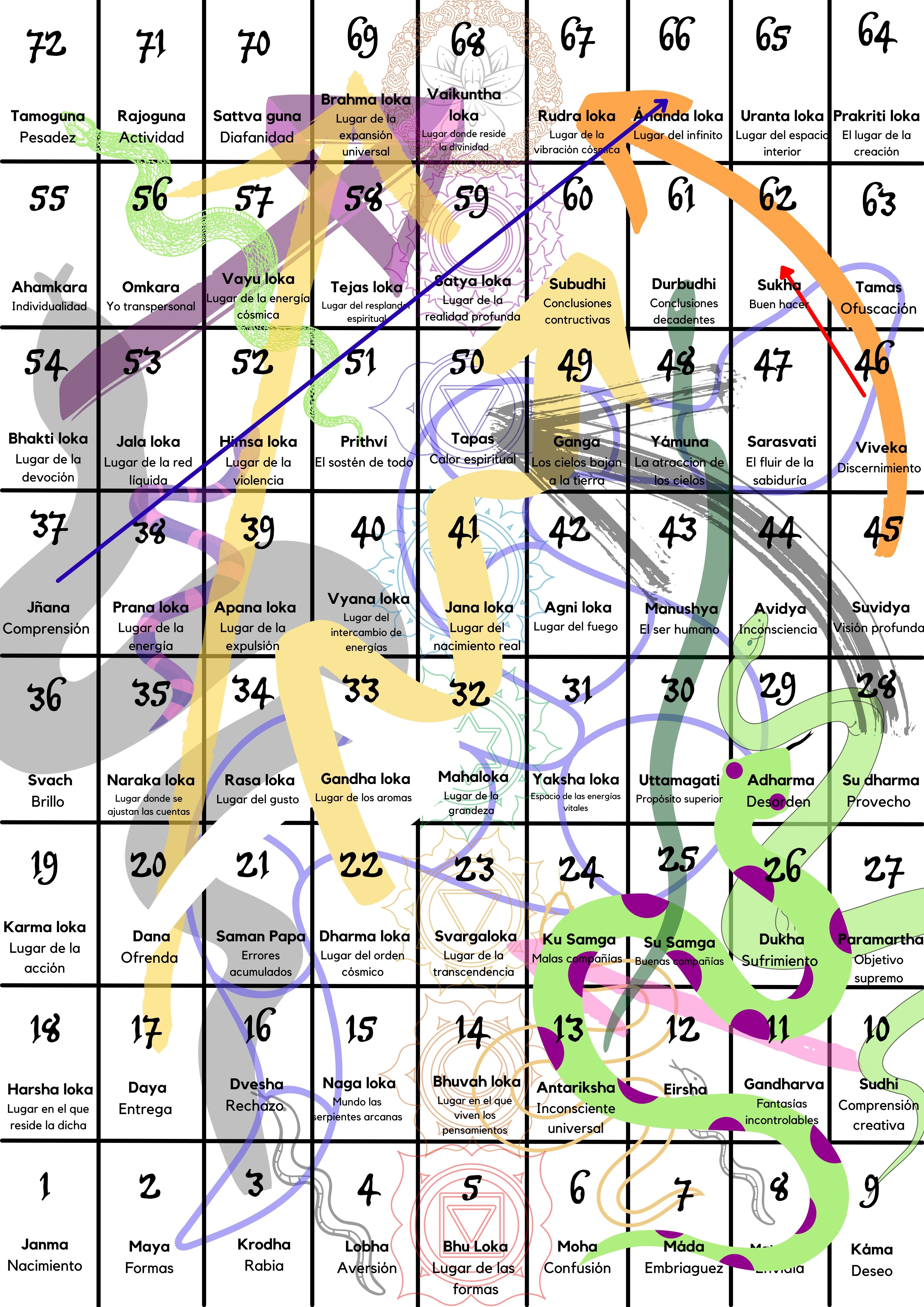
The game of Gyan Chaupar, or Mokshapada (the path of liberation), is an Indian board game that reached Europe in the nineteenth century as Snakes and Ladders. Copied from its Indian predecessor during the Victorian period, it was marketed from 1860 in the United States by board-game manufacturer Milton Bradley.
There is evidence of the game in India from the early centuries of the Common Era, although the oldest surviving physical boards are no earlier than the nineteenth century. Unlike other Indian games such as pachisi or chess, Mokshapat boards are always made of paper.
Playing can open us to the Mahabharata’s symbolism. This is why we have played it at some of my shorter storytelling sessions and why it accompanies the December telling. In the original invitation, I suggested printing the board shown here and playing a few rounds, whether attending on 12 December, visiting Mailuna for a personal story, or simply wishing to enjoy the experience. You can play alone, but it is more enjoyable with others.
Use one die. Instead of conventional counters, I recommend small personal objects: a ring, hairpin or bracelet.
All players place their symbols on square 68, cosmic consciousness, and roll until they obtain a six. It is interesting to observe how a six seems to come more easily when the intention for playing is clear.
On rolling a six, the player moves to the first square and rolls again. Players then take turns rolling once and advancing by the number shown. Landing at the foot of a ladder takes you to its upper end. Landing on a snake’s head takes you down to the square reached by its tail.
A six grants another roll; a second six grants another. A third consecutive six returns the player to the square occupied before the first of those rolls—eighteen squares back.
Each player finishes upon returning to square 68.
The names of the squares
Each square has a name, and the player passes through them towards square 68. The names are Sanskrit philosophical terms.
The difficulty with Sanskrit is that its use is primarily religious and ritual. A dictionary supplies philological translations, comparing written documents and defining how each word is used in them. Yet an oral transmission runs alongside Sanskrit texts and can substantially change a translation. Squares 48 and 49, Yamuna and Ganges, offer an example: ancient texts name Indian rivers, while some tantric treatises use them as symbols for the body’s energy channels. A translation should mention both uses, but understanding the channel called Yamuna requires experiencing it and knowing its use. This is learned through practice, not from a book. Speaking with authority about certain Sanskrit terms requires spiritual mastery.
In these translations, I combine dictionary meanings with explanations by Harish Johari, an Indian author who published an English account of the squares in the 1970s. I consider his book by far the best, with profound explanations. I quote him where possible; elsewhere I avoid excessive quotation, but recommend buying his book as a guide to anyone wishing to go deeper.
I also add passages from other texts and stories from the Puranas, collections of Indian sacred narratives, and the Mahabharata.
I thank Patricio Mango for helping with the board’s final design.
Readers are welcome to comment or add to the explanations. With enough participation, this resource could become a collective account of the game’s squares.
1. Janma Loka
The six subtle elements approach a consciousness and the game begins. Desire binds us to the board; its rules can no longer be ignored.
2. Maya (Māyā)
The secret of learning. The mind, which is energy, interprets the electrical impulses affecting the senses. The player enters the board after birth or becomes entangled again in the mind’s interpretations of reality after falling from square 63.
3. Krodha — anger
Anger is energy held back because it does not know how to expand. Important questions: why am I angry? Do I wish to remain angry? How can I remain angry if I choose to, or cease to be angry if I do not?
4. Lobha — greed
A double or triple interpretation of reality. The player takes perceptions not as interpretations by the senses but as external objects, then projects pleasurable qualities onto those projections. Greed longs for another player’s imagined happiness without knowing how that person’s consciousness experiences reality.
5. Bhu Loka — the physical plane
The central squares correspond to the chakras; the board’s centre is its spine. The first row corresponds to the first chakra, the plane of material aims.
6. Moha — illusion or confusion
Square 2 welcomes us to the play of perception and interpretation. Moha, delusion, means believing our own interpretations: the player assumes reality is exactly as they think it is.
7. Mada — madness
The difference between moha and mada is difficult to define; they are almost synonymous. Moha, illusion, is one of four characteristics of the material plane, alongside kama (desire), krodha (anger or cruelty) and lobha (greed). Mada could be understood as a misuse of moha. Its root is related, in this reading, to the English word mad. Within the game, bad company is one route to mada.
8. Matsarya — greed
The player feels separate from the world and more deserving of certain goods than others. This sense of lack causes pain, but it is not eternal: the die keeps turning.
9. Kama Loka
The sensual plane, at the end of the first-chakra row, one square before well-being. Reaching it after traversing the first row can suggest that basic fears are balanced and the game begins to be enjoyed sensually. Descending here from obscuration may invite the player to reconsider their relationship with desire.
10. Shuddhi
Literally, in this interpretation, well-being. An arrow leads from here to square 23, the centre of the third row: the heavenly plane.
11. Gandharvas
Astral beings who accompany the gods with music. Might they guide human inspiration towards subtler planes of sensuality?
12. Eirsha — envy
Envy arises from feeling separate from the world’s pleasures. The player discovers ways of enjoying the game that they believe others possess and they lack. This brings them back to the fear of not having: the first row, the fear of survival.
13. Antariksha
Also a Sanskrit name for ether, the subtle space through which creation expands. From the sensual perspective it is expansive and subtle, yet the game associates it negatively with an uneasy conscience. Ether is not the goal of the human search here, but one element of the game.
14. Bhuvar Loka
An esoteric term for the atmospheric plane where the gods’ helpers, such as the gandharvas of square 11, live. Its interpretation varies between schools. Johari calls it the astral plane, where the player begins to recognise possibilities beyond physical survival.
15. Naga Loka
Nagas are serpentine beings living between planes. Some destroy, while others sustain universal order. Dreamlike or magical, they connect the physical and subtle. The parallel with the gandharvas in this row is striking. Knowing different naga stories may allow the word’s meaning to mature within us. Johari associates this square with an explosion of artistic creativity. The snake of jealousy lies immediately beside it, at square 16.
16. Dwesha — jealousy
The player’s creativity coils around invented ways of seeing reality. Believing they can inhabit another’s viewpoint, they imagine realities better or worse than their own, and think life would be better as someone else, another symbol.
17. Daya — compassion or surrender
The ascending version of the previous square. The player imagines interpretations different from their own, becomes flexible enough to learn from each situation and sensitive to other players’ needs. Empathy’s flexibility carries the player to square 69.
18. Harsha Loka
Harsha is usually translated as pleasure. Its verbal root hrish (hŗish) encompasses meanings of excitement, including male sexual erection. The square ends the second row, just before the third, the plane of action in the world. Each player can ask: what is pleasure in my life? When does it appear, and when does it hide?
19. Karma Loka
Under the law of karma, experience balances the consequences of our family’s, humanity’s and the earth’s past actions with our own decisions. We can influence karma, but we always live with the consequences of our lineage’s and humanity’s previous moves.
20. Dana (Dāna)
A gift, offered without expecting anything in return. Johari relates it to an opening in the ego through which the player connects with the desire to give, a principal element of the game. This square leads directly to the heart’s plane.
21. Saman Papa Loka (sāman pāpa)
Sāman means to quiet or calm; pāpa is close to sin or evil, understood as acting against what one knows to be good. Each player can reflect on knowingly acting wrongly. Johari notes its position in the third row, where the player begins choosing a life path, immediately before Dharma.
22. Dharma
Dharma cannot easily be defined in a few words; each player should investigate it. My preferred reading is the intrinsic nature of things. As a leaf has its dharma of withering and falling, humans have individual, family, collective and universal dharmas. What does arriving here mean to this player? It is a question to answer silently and honestly.
23. Svarga Loka
The root svar is related to sur in Surya, sun. Svarga is the path to svar: light, sun or the plane of the gods. Usually translated as paradise, it invites players who repeatedly arrive here to ask what such metaphors mean for them. This third central square corresponds to the third chakra. Johari describes paradise as the lure used by saints and prophets to draw those lost in the first two chakras back to a spiritual path and raise humanity’s spiritual level.
24. Kusaṃga Loka — harmful surroundings or company
Experience teaches that living a certain way requires choosing a compatible social environment. Square 24 descends to 7. Perhaps imagining ourselves fundamentally different from those accompanying us is a kind of madness?
25. Su Saṃgha — good company
Saṃgha literally conveys a cluster, heap or multitude. Many spiritual practices speak of sangha, the Pali form of Sanskrit saṃgha, as the community of practitioners. Little needs saying about good company’s effects. This square offers a moment to pause, reflect and, if desired, give thanks for one’s companions.
26. Dukha (dukḥa)
Usually sorrow or sadness, but also difficulty or discomfort: obstacles on the path, just before the end of the third row.
27. Paramartha (paramārtha)
Artha means aim or purpose and, in Indian philosophy, also material goods. Knowing how to relate to possessions matters as much as understanding Dharma, also in the third row. The Arthashastra, developed in the early Common Era, advises a king on managing possessions in ways recalling Machiavelli’s The Prince: this relationship need not be ascetic. Param means higher. In the row of projecting oneself into the world, what is the highest or ultimate possession? This square rises to Jana Loka, square 41. Johari interprets it as selfless action: the greatest possession is what we give, rather than keep.
28. Sudharma
Dharma sustains the universe. A mystery debated by religions is how human freedom to act well or badly coexists with a universal course and laws we cannot bend. Su means good; sudharma is right dharma, opposed to the next square. How can dharma be right or wrong? Johari suggests musicians find it in music and painters in art. Among the seven psychic centres in which a player vibrates, the one where they feel at home can become the basis for developing energy into new patterns.
29. Adharma — not following universal order
Dharma could fill encyclopaedias; adharma means not-dharma. Johari translates it as non-religion, understanding religion as inherent to human development. Since contemporary thought struggles with religion, I propose moving beyond disputes about its name and importance and using universal order. Humans have a nature, as trees and birds do. Failing to follow it sends the player to square 6. What is human nature?
30. Uttamagati — positive tendencies
Uttama means supreme, gati going or movement. This square opens the fourth row, the heart’s vibration and the opening to empathy. Johari explains that when empathy opens, the player’s actions or movements naturally become positive.
31. Yaksha Loka
The Puranas and Mahabharata often mention yakshas but rarely describe them. They seem benevolent spirits, perhaps subtler than the second row’s gandharvas. Worshipping a tree or flower is said to honour its resident yaksha. These deeply symbolic stories permit complementary readings. Johari suggests understanding such beings as states of mind: here the heart opens and the player sees mystery in every object.
32. Mahar Loka
The fourth plane of existence, connected with the heart chakra. Johari calls it the plane of balance, but heart plane is also appropriate: it is the fourth row’s centre, where the game enters the heart. He relates it to Sufi devotion. One can arrive by advancing or directly through giving without expectation. Each player may interpret the square as they feel.
33. Gandha Loka — fragrance
Gandha literally means fragrance. What does its plane mean in the fourth row? Johari suggests that opening to the heart changes how the player perceives the world’s smells.
34. Rasa Loka — taste
The Natya Shastra (Nāṭyaśāstra), a central Indian treatise on dance or performance, describes eight basic flavours (rasa) that art can evoke. Their right combination can produce a ninth, unrepresentable flavour: shantam, peace. The eight are śṛṅgāra (love), hāsya (humour or laughter), raudra (fury), kāruṇya (empathy or compassion), bhībatsa (disgust), bhayānaka (fear), vīra (heroism) and adbhuta (wonder). If you often arrive here or feel drawn to this square, Chantal Maillard and Oscar Pujol’s excellent annotated Spanish translation, Rasa, el placer estético en la tradición india (Etnos), offers further study.
35. Naraka Loka
A terrifying infernal underworld where the dead suffer cruel, bloody consequences for their actions in life. It resembles hell, except it is never eternal: passage through Naraka is temporary, because the die keeps rolling.
36. Svaccha
Transparent, crystalline or healthy. On the board it sits immediately beside Naraka, one step before the fifth row and true knowledge.
37. Jñana
Jñana refers to acquired knowledge. The Bhagavad Gita speaks of jñana yoga, union with the whole through deep knowledge of reality. I think this square invites players to ask what they consider knowledge, whether they have too little or too much, and where they might find it.
38. Prana (Prāṇa)
Universal energy. From this fifth row onwards, squares bear names for profound concepts that require a spiritual teacher’s guidance to explain properly. For lay players, arriving at each square can be an invitation to investigate the concept and our relationship with it.
39. Apana (apāṇa)
The channel through which residual energy leaves the body. As with the neighbouring squares, these fifth-row concepts call for a spiritual teacher’s guidance if they are to be explained properly. For lay players, landing here invites enquiry into the concept and their relationship with it.
40. Vyana
That which carries energy between bodily organs. The fifth row refers to elements balancing the human body within a non-dual understanding of reality. They exist both in human bodies and in the earth’s body. Passing through, we may use the game’s inspiration to understand the tradition’s account of them more deeply.
41. Jana
The Puranas describe a universe cyclically created and destroyed. Jana Loka is so subtle that it does not disappear during universal destruction; coarser planes do, and Brahma recreates them at his next birth. Siddhas, beings who have attained mystical powers, shelter here during that destruction. This square marks the fifth row’s centre, where, according to Johari, the player begins attuning to divine laws.
42. Agni Loka
Agni is fire. The Mahabharata tells how fire once wished to withdraw from the universe because it was being compelled to become omnivorous. All creation, including the gods, begged it to remain. Though it would consume everything, whatever was offered sacrificially to its blue, red and yellow crests would pass directly to paradise. What do we offer our fire?
43. Manushya Janma
The fifth row’s central square is called birth, followed by fire and then human birth. Indian sacred stories describe an original being—Prajāpati or Brahma—whose repeated birth and death form the universe. Expanding to create, it becomes stretched and slack, leaving the universe without strength. It invokes fire within itself, restoring strength throughout its expansion. Another telling describes this as self-sacrifice: it offers itself to fire, and the universe begins taking form. A first generation of gods lasts as long as the universe; in the second or third divine generation, the first mortal, Manu, is born. Humans descend from Manu, the gods’ mortal son. What is the place of Manu’s children in the universe?
44. Avidya — lack of knowledge
Greater clarity and relinquishing harmful attitudes allow a richer, subtler experience of the game. Yet these discoveries may bring attachment to a new kind of sensuality. The player must return to the sensual plane and reconsider why they are playing.
45. Suvidya — understanding
Su means good, and also evokes the pressing of Soma, the elixir of immortality. Words bearing this prefix have positive associations. Su-vidya, good vision or knowledge, opposes avidya. It ends the fifth row, with an arrow to Shiva’s plane.
46. Viveka — discernment
The prefix vi conveys separating or setting apart; the verb vic means to discern or distinguish. Viveka appears throughout Indian philosophical and religious texts. Discernment is the quickest translation, but studying its philosophical use is preferable. It is central to Buddhist discourse too. Discernment opens the sixth row, which contains the board’s most esoteric squares, and raises the player to happiness.
47. Saraswati
The Ganges and Yamuna flow parallel until they meet; between them flows a third river not shown on maps, Saraswati. Yogic teachings describe an inner Ganges as the feminine energy channel and an inner Yamuna as the masculine. When balanced, Saraswati flows through the body’s centre. These three names appear together on squares 47–49.
Saraswati means one who possesses fluid or can flow, and names Brahma’s companion. In one account of how Brahma lost his fifth head—another appears at square 67—he emanates his companion and desires her. White and chaste, Saraswati refuses his desire and flees. She creates a second dimension behind him and slips into it. Brahma grows a second head to follow her. A third and fourth dimension produce further heads, giving matter four dimensions. When she creates a fifth dimension above his crown, he grows a fifth head; Shiva appears to put creation in order and cuts it off. Discernment seems crucial to crossing this sixth row.
48. Yamuna
The river running parallel to the Ganges also names the body’s masculine energy channel, pingala, the solar channel associated with the right nostril. Some breathing exercises alternate nostrils, but I do not have the expertise to recommend them. This square may call players to investigate its relation to the other squares they have crossed.
49. Ganges
The river running across northern India is associated by Johari with ida, the energy channel on the body’s left side and its feminine energy. In sacred stories, Ganges is a goddess who can appear as a river or a human woman. Once, in heaven, the wind lifted her garment. All the gods lowered their gaze except a divine king captivated by her naked body. For his imprudence, he was condemned to earthly birth and forgetfulness, but Ganges fell in love with him.
Meanwhile, the eight Vasus, protective divinities close to the human plane, tried stealing a heavenly sage’s cow of abundance. He condemned them to human birth. They wept, unwilling to live on earth, until an agreement allowed their births to last only an instant. Ganges emerged from her river as a woman just as the king passed. He fell in love and asked her to be his lover. She agreed on condition that he never ask who she was or question her actions. They spent thousands of years making love, forgetting the world in their ecstasy.
The king’s only distress was that every time Ganges bore a child, she cast it into the river. This happened seven times: each child was a Vasu, briefly born on earth before returning to heaven through her waters. At the eighth birth, the king could bear it no longer and begged her to explain. Sorrowful, she told him the children were Vasus longing to return to heaven; because he had questioned her, she must leave. Loving him and seeing his longing for descendants, she left the last baby with him. Thus one Vasu lived through the Mahabharata’s turbulent times as Bhishma. Some sources identify that Vasu as Vāyu; others say each of the eight contributed one eighth of themselves. The king never truly lost Ganges, only her human form: he could visit the river daily.
This story may speak differently when read out of curiosity than when the die brings you here. A player arriving through the game will probably draw a deeply personal conclusion.
50. Tapas Loka
The verbal root tap means to heat or radiate heat; tapa can mean to consume through heat. Tapas literally means heating, burning or shining: what the universe does. When only waters existed, Brahma was born from Vishnu’s navel and performed tapas, producing heat within the waters. He made them boil like an inextinguishable flame at the bottom of the sea. From their boiling arose the golden embryo or cell: the whole universe of the stories, its three worlds, gods and humans. Whenever a saint or demon performs tapas, they rise to Brahma’s level and he offers them a boon. How is tapas practised today? How is Brahma’s heat produced in our time?
Square 50 centres the sixth row and sets its tone. Amid its esoteric squares, it invites reflection on asceticism and its motivations. Sacred stories say suitable asceticism can grant powers considered magical, but this is not liberation: square 68 remains far away.
51. Prithvi (pṛthvī) — earth
Prithvi means she who belongs to Prithu. When humanity became so corrupt and abusive that the earth stopped yielding fruit, the just King Prithu spoke with her. She explained her suffering and asked him for a suitable calf to nourish with her abundance. He formed a calf from Manu, humanity’s archetypal ancestor, and broke mountains with arrows to create valleys and rivers. Since then, the earth suckles her calf and is called Prithvi.
Players can reflect on what earth means to them and on the path traced in this sixth row. For one who has passed square 68, obscuration at square 72 offers another journey through earth towards Vaikuntha. Earth is a refuge, an opportunity to play: the board itself.
52. Himsa Loka (hiṃsa)
Himsa means harming or wounding. On the game’s most esoteric row, violence sends the player back to Naraka and the difficult process of acknowledging harm done while playing. The dictionary uses hiṃsaka, one who harms, for an animal predator or an expert in the Atharva-Veda’s magical texts. Might this square warn against using esoteric knowledge for personal ends? Johari warns against reading the doctrines of oneness or the soul’s passage between bodies as permission to kill or do whatever one wishes. Even if life is seen as a game, no player is entitled to end another’s participation.
53. Jala Loka
The watery plane. Ganges, Saraswati and water meet in this part of the board. What fluidity does crossing it require? From where to where does the universe flow? Johari draws attention to water’s combination with fire and to the human body’s largely liquid composition. What gives liquid its form?
54. Bhakti Loka
Bhakti derives from bhaj, a verbal root encompassing partition, division and distribution. Depending on context, bhakti can mean distribution, portion, part, decoration, succession, order, belonging, attribute—and homage, devotion, faith or love. It is best known as devotion in Indian religious and mystical practice. Its etymology illuminates devotion’s depth.
The player leaves square 68, cosmic consciousness in Johari’s words, or Vishnu’s plane, only to return there. Bhagavad Gita 18:61 describes the Lord dwelling in every being’s heart, moving beings upon a yantra made of illusion. A yantra may be a diagram, geometric pattern, symbol or game board. The Sanskrit word rendered illusion is Maya, the board’s second square. Devotion belongs to the game through which that which resides at 68 moves the players’ symbols. It takes the player directly back to 68.
55. Ahamkara — I do
The player interprets reality’s transformations as personal achievements or events directed against them. At this high level, the obstacle is believing that positive changes in one’s habits result solely from personal work. A subtle separation from the surroundings emerges: as Johari explains, the player stops identifying with the environment. Even this slight separation nourishes frustration and returns the player to the first row’s anger.
56. Omkara
If a literal translation is possible, omkara suggests the action of om. Dictionaries give the utterance of the syllable om, since om (auṃ) is a sound and sounds are uttered rather than made. Yet om is also what we are, because everything is sound. After its opening trap, the sixth row becomes the most conceptual row. Square 56 is the action of Om. Johari recalls that all knowledge underlying the game emanated from aum.
57. Vayu Loka
Vāyu names the god of wind, air, breezes and subtle currents passing through bodies. What is a god? Adi Shankara’s Advaita commentary on the Brahmasutras discusses divine multiplicity through the Brihadaranyaka Upanishad. A passage counts gods in hundreds and thousands, then explains that these are powers of thirty-three deities. The same being can appear simultaneously in many forms. The number is reduced to six, five and so on, until the question of the single divinity is answered with vital energy, Hiranyagarbha. The gods are forms of life, and life can appear in many forms. The Spanish source quoted here is Consuelo Martín’s edition for Trotta.
On the seventh row, the player enters the plane of powers. Vayu is the power carrying energy: subtler than liquid, less subtle than light.
58. Tejas Loka
Tejas means brilliance, radiance, virile energy or even semen. Rather than claim expertise, I turn to the sacred stories I know. Rishis, human embodiments of oracular wisdom, perform difficult ascetic restraints and mortifications, accumulating tapas, heat, which can be transmuted into tejas: a subtler energy recognised as radiance. Often these practices involve retaining seed, avoiding sexual excitement and transforming semen into bodily heat, brilliance and mystical powers. Hence the dictionary’s meanings of both semen and radiance.
The accumulated powers make Indra fear displacement as king of the gods. He often sends an apsara, a celestial dancer made of raindrops, to seduce the rishi and dissipate his tejas. The consequences of each encounter for the earth’s destiny are especially interesting. These stories may help each player intuit what landing here means.
59. Satya Loka
Sat is a Sanskrit participial form of being, associated with asti; satya is what belongs to being—something like beingness. It is what is, what exists, and is therefore translated truth. Truth is what is actually happening. Centred in the seventh row, Satya Loka also evokes the seventh chakra. This row concerns reality’s concepts, or reality as it is. The player is still short of Vaikuntha.
61. Durbuddhi
Buddhi is translated here as consciousness. Durbuddhi, negative consciousness, returns the player to sensuality. I think of a dedicated meditator satisfied with the detachment produced by practice, who loses interest in going further.
62. Sukha — happiness
Etymologically, su-kha may originally suggest a chariot with a good axle. Its common meaning in early Sanskrit texts is pleasant—perhaps fluid, stable, running smoothly like a well-oiled wheel. What matters is what sukha means to the player and what the game is saying. Happiness lies on the penultimate row, just before the divine plane, amid planes of reality from physical to subtle. Reached through discernment, it stands between two long snakes: tamas and durbuddhi.
63. Tamas
Indian tradition speaks of three fundamental qualities: Sattva, Rajas and Tamas. I do not think they can be translated properly without some experience of them. Bhagavad Gita 14:16 associates selfless action with sattva, passionate rajas with pain, and tamas with ignorance; 14:17 connects sattva with understanding, rajas with desire and ambition, and tamas with confusion and error. Further passages describe austerity intended to harm oneself or others as tamasic (17:19), and gifts given at the wrong time or place, to an unsuitable recipient, disrespectfully or contemptuously, as tamasic (17:22). Tamas waits even on the penultimate plane, should the game need to begin again from the lowest row.
64. Prakriti (prakṛti)
Poetically, universal consciousness and matter—purusha and prakriti—are like a lucid old man unable to walk and a blind dancer who are always together. Prakriti dances every possible form for purusha to observe matter’s possibilities. Her dance opens the final row, leading to the gods’ plane.
65. Uranta Loka
Ura means chest, sometimes lungs and, according to Johari, heart. Anta is an extremity. On the eighth row, Uranta suggests the heart’s farthest reaches, the limits of inner space. These limits are the atoms and subtler particles composing us. Believing this differs from perceiving it. How do our atoms differ from those in the universe? How do atoms in a man’s body differ from those in a woman’s, and how do they combine for another group of atoms to become a third living human? This square is still not Vaikuntha.
66. Ananda Loka (ānanda-loka)
The plane of bliss. From Ananda come the game’s most significant squares: the divinities and qualities forming reality’s board. Here, missing Vaikuntha and continuing can be pleasurable, because play and the die’s movement make arrival possible. The relationship between dice and gods is striking: deva, god, derives from div, whose uses include throwing and chance. Chance, together with intention, allows us to return to Vaikuntha through the board.
67. Rudra Loka
Rudra, the howler, is an old name for Shiva. He gathers what remains of the gods’ sacrifice, yet all gods fear him. One story tells how gods lose teeth, hands and limbs while invoking Soma without offering Shiva a share. The square is enigmatic: some traditions understand Shiva as equivalent to or more transcendent than Vishnu, yet this game ends only by returning to Vishnu’s plane.
Once Brahma and Vishnu encounter the linga, a column of fire with no visible beginning or end. They agree to travel in opposite directions and see who can reach an extremity first. Vishnu becomes a shining white boar and descends to seek its base; Brahma flies upwards. Seeing a tropical ketaki flower falling, Brahma returns with it as false evidence that he has reached the top. Vishnu returns humbly admitting he has not found the base. Shiva cuts off Brahma’s fifth head for lying, while promising Vishnu worship in all three worlds for his sincerity.
Shiva says he will be born howling from Brahma’s head to give creation form, while Vishnu protects it by defeating enemies and taking incarnations that attract countless devotees. Anchored in sincerity, Vishnu can ask Shiva to act and he will. In Johari’s formulation, cosmic good has truth as its essence and beauty as its form. Reaching Rudra does not end the game: a one leads to Vaikuntha, a five to Tamas, and the rolling continues.
68. Vaikuntha Loka
In mythic language, Vishnu’s paradise. Everything departs from and returns to this square. Each player must find their own relationship with it.
The Harivamsha, an appendix to the Mahabharata, tells of Prahlada, a child inclined to sainthood and the son of a demonic king. Sharing spiritual knowledge with his furious father, Prahlada explains that the entire world manifests Vishnu, who is identified with everything: the wise should not see him as separate from things, but as one with them. His father throws him from a palace balcony overlooking a precipice. Falling through the starry sky and repeating Vishnu’s name, Prahlada is received tenderly by the earth and escapes injury from what would otherwise have been a fatal fall.
69. Brahma Loka
Mythologically, Brahma is born from Vishnu’s navel to expand and shape creation. Yet Brahma is not eternity: he is a mystery, among reality’s subtlest phenomena, but not transcendent. In Samkhya philosophy this plane might be called Mahat Tattva. Johari explains that Brahma determines the game’s forms, but the game contains more than form.
70. Satoguna
The quality of Sattva. Indian tradition describes three fundamental gunas: Sattva, Rajas and Tamas. They require experience to understand. Bhagavad Gita 14:16 relates selfless action to sattva, rajas’s passion to pain, and tamas to ignorance. Verse 14:17 relates sattva to understanding, rajas to desire and ambition, and tamas to confusion and error. Verse 14:9 describes attachment through happiness, action or obscuration respectively. The source also invokes knowledge arising from sattva and 14:19: recognising the gunas as the actors, and perceiving what lies beyond them, brings one to Krishna’s essence.
71. Rajoguna
The quality of Rajas. The three fundamental qualities are Sattva, Rajas and Tamas, whose meanings cannot properly be translated without lived experience. Bhagavad Gita 14:16 associates selfless action with sattva, rajas with pain and tamas with ignorance; 14:17 associates understanding with sattva, desire and ambition with rajas, and confusion and error with tamas. Verse 17:18 describes spiritual practice performed for reputation, honour, praise or display as belonging to rajas’s passion.
72. Tamoguna — obscuration
The material world is composed of three gunas: Tamas (obscuration, darkness, heaviness), Rajas (action, heat, movement) and Sattva (clarity, transparency, lightness). Tamas appears twice, here and at square 63. Both return players through the board if their experience lacks depth. The first sends them back to basic fears on the lowest row before entering the divine one. The second, at 72, allows play to continue through the esoteric row when the player has become caught in the higher spheres.